Conjunction (Basic ㊦ 461)
Even if someone did something or something were in some state (the desired result would not come about) or even if someone or something is in some state.
Equivalent: Even if ~
| (i) Vinformal past | って | |
| 話しって | Even if someone talks/talked | |
| 食べだって | Even if someone eats/ate | |
| (ii) Adjective い stem | くたって | |
| 高くたって | Even if something is/were expensive | |
| (iii) {Adjective な stem/ N} | だっ(たっ)て | |
| 静かだっ(たっ)て | Even if something is/were quiet | |
| 先生だっ(たっ)て | Even if someone is/were a teacher |
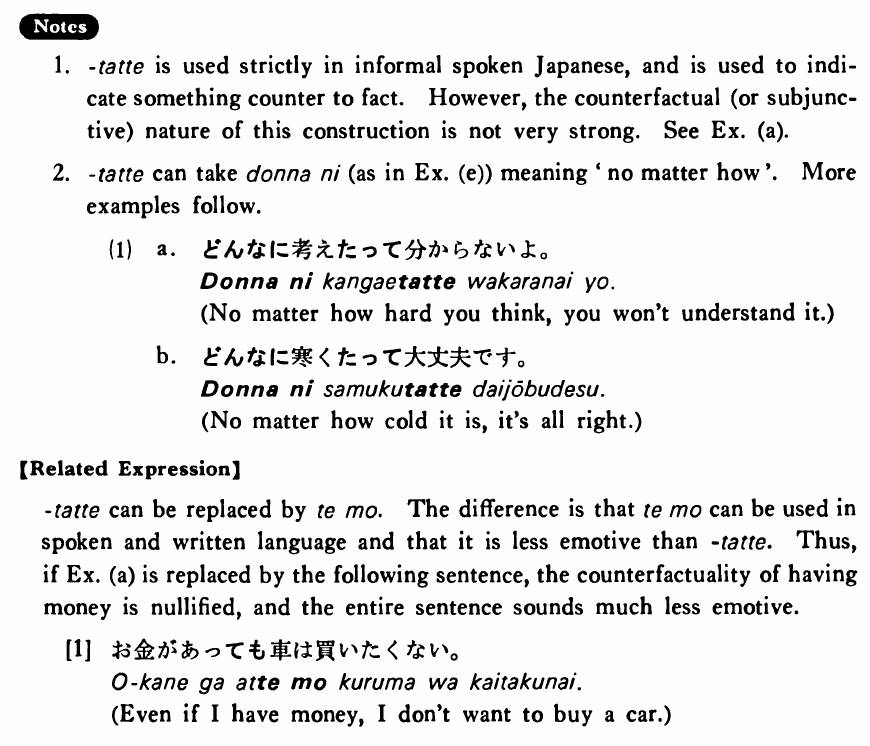
1. たって is used strictly in informal spoken Japanese, and is used to indicate something counter to fact. However, the counterfactual (or subjunctive) nature of this construction is not very strong. See Example (a).
2. たって can take どんなに (as in Example (e)) meaning 'no matter how'. More examples follow.
【Related Expression】
たって can be replaced by ても. The difference is that ても can be used in spoken and written language and that it is less emotive than たって. Thus, if Example (a) is replaced by the following sentence, the counterfactuality of having money is nullified, and the entire sentence sounds much less emotive.
[1]